
DeSantis slams California while siding with Trump on American citizenship: “They come, have a kid, and leave”
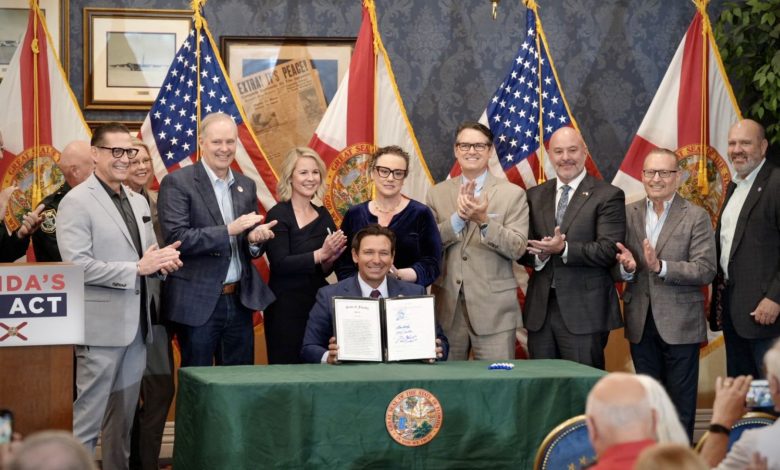
Florida – As a renewed national debate over citizenship unfolds, Ron DeSantis used a policy-focused appearance to connect two issues he argues are closely linked: the integrity of elections and the meaning of American citizenship itself.
While signing House Bill 991, a sweeping election reform measure, DeSantis stepped into a broader constitutional conversation that is now sitting before the U.S. Supreme Court.
The moment is not accidental.

At the same time DeSantis spoke, justices were weighing whether an executive order from Donald Trump, one that seeks to limit automatic citizenship for certain children born on U.S. soil, can stand.
The order, signed early in Trump’s presidency and quickly blocked by lower courts, would require at least one parent to be a U.S. citizen or permanent resident for a child to receive citizenship at birth.
DeSantis framed the issue in blunt terms, arguing that modern travel and immigration patterns have stretched the original intent of the 14th Amendment.
“I don’t think [Reconstruction-era lawmakers] intended someone to just come here on a visit who’s foreign, have a kid, then go back, and then that kid becomes an American citizen,” DeSantis said during a press conference, the Florida Phoenix reported.
“That kind of cheapens the process when you make it a tourist thing.”
He pointed to data highlighted by the Pew Research Center showing that roughly 9 percent of births in the United States in 2023 were to mothers who were either in the country without legal status or present on temporary visas. For DeSantis, that figure underscores what he described as a system operating far outside its original design.
“I’m not anticipating them passing a Save Act federally, and I know there’s a lot of states that need a lot of work — including California,” DeSantis said.
“But I think you guys here should be comforted in the fact that Florida, yet again, is ahead of the curve.”
Governor Ron DeSantis Signs Florida SAVE Act to Bolster Election Integrity https://t.co/tSxJsEB5Sr
— Ron DeSantis (@GovRonDeSantis) April 1, 2026
The constitutional language at the heart of the dispute is brief but powerful: anyone born in the United States and “subject to the jurisdiction thereof” is a citizen.
Historically, that clause has been interpreted broadly, with narrow exceptions such as children of diplomats. The Trump administration, however, has argued that the phrase should not extend to individuals whose parents lack permanent legal status.
Inside the courtroom, that argument has faced resistance.
During oral arguments, Chief Justice John Roberts questioned whether expanding such exceptions would stretch the amendment beyond recognition, reportedly describing aspects of the reasoning as “quirky.” The exchange reflected a deeper uncertainty about whether long-standing interpretations can be reshaped without fundamentally altering constitutional precedent.
DeSantis, aligning with the administration’s broader position, said the amendment’s authors were addressing a very different reality in the aftermath of the Civil War. Travel was limited, immigration patterns were slower, and lawmakers were focused primarily on guaranteeing citizenship to formerly enslaved people.
“Coming to America was a big deal,” he said, emphasizing that quick, short-term visits followed by departure were not part of that historical context.
Even so, he acknowledged the court may ultimately reject the current legal push, adding that clarity from the justices would still be valuable given that the issue has never been directly settled in this precise form.
Safeguarding the electoral process to improve oversight and prevent unlawful influence has been a top priority for my administration since my first days in office. Today in The Villages, I signed the election integrity bill HB 991, also known as the Florida SAVE Act. This… pic.twitter.com/tYRu1F5B4f
— Ron DeSantis (@GovRonDeSantis) April 1, 2026
That constitutional argument unfolded alongside DeSantis’ push to solidify Florida’s election system. House Bill 991 builds on years of reforms, introducing stricter voter identification requirements, mandating paper ballots for auditability, and increasing penalties for election-related crimes. The measure also requires candidates to disclose dual citizenship and report stock trading activity while in office.
Tracing Florida’s trajectory from the disputed 2000 presidential recount to what he described as rapid, same-night vote tabulation in recent elections, DeSantis cast the state as a model for national reform.
“Our constitution in the State of Florida says only American citizens are allowed to vote in our elections, and so we need to make sure the law reflects that,” DeSantis said.
In his telling, both debates, how votes are counted and who qualifies as a citizen, are part of the same underlying question about the structure and credibility of democratic governance.
DeSantis also criticized Pennsylvania for accepting ballots after Election Day with no postmark and said states like Arizona take weeks to produce results. In Florida, DeSantis said more than 10 million votes in the 2024 presidential election were counted and reported the same night.
As the Supreme Court deliberates, the outcome could reshape not only immigration policy but also the boundaries of a constitutional guarantee that has stood, largely unchanged, for more than a century.


